There is a quiet tension many young doctors carry. A desire to help. To care. To connect. Alongside it sits relentless time pressure, overwhelming responsibility, and a system that often leaves little room for the very empathy that drew them to medicine in the first place. It can begin to feel like something has to give.
Care or efficiency. Compassion or survival
Dialectical Behaviour Therapy (DBT) offers a way of holding this experience without asking doctors to harden or switch off. It supports them to stay human within the reality they are working in. At its heart is a simple idea. Two things can be true at once. You can care deeply about your patients and not have enough time to show that care in the way you would like.
When this tension goes unspoken, it often turns inward. Guilt. Self doubt. A quiet sense of falling short. Therapy helps loosen that grip. It shifts the focus from personal failure to context.
I am not failing. I am working within constraint.
Even that small reframe can ease some of the pressure, In the moment, when everything is moving quickly and there is no time to pause, therapy with me offers small, usable ways to steady yourself. A breath between patients. Feeling your feet on the ground. The mindfulness "STOP" practice and The Gestalt 'cycle of exerience' letting one interaction end before stepping into the next, nothing elaborate, just enough to stay present rather than shutting down.
As a therapist I've seen that is often what happens, not a loss of care, but a gradual numbing in order to cope. Over time, constant exposure to distress without space to process it can lead to spiralling anxiety, compassion fatigue. Emotions flatten. Conversations become functional. The work continues, but something important starts to fade.
There is a particular kind of anxiety that can begin to spiral when there simply isn’t time to be as kind or as present as you want to be. It doesn’t just sit at the surface, it gets under the skin. A rushed interaction replays later. A moment you wish you had handled differently lingers. Slowly, it starts to shift from “that wasn’t ideal” into something more personal. Doubt creeps in. Am I cut out for this? Do I actually know enough? Should I have chosen this path at all? What begins as a lack of time turns into a questioning of self. Knowledge feels less solid, decisions feel heavier, and the gap between the doctor you hoped to be and the one you feel you are becoming can feel uncomfortably wide.
Therapy helps protect against this by encouraging awareness of what is actually there. Frustration. Helplessness. Sadness. Naming it, even briefly, can stop it from building up.
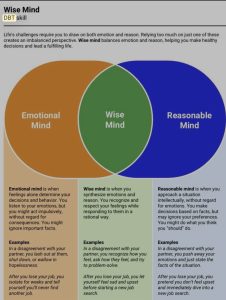
It keeps things moving on the inside. There is also the idea of 'Wise Mind'. The place where thinking and feeling sit alongside each other. For a young doctor, this might be making clear clinical decisions while still offering a moment of real presence. Not more time, but a different quality of attention within the time that exists. A pause, Eye contact, A simple acknowledgement "This is hard". These moments are small, but they land. There is something deeper running through all of this. Moral distress. Wanting to work in a way that reflects your values, and being constrained from doing so. That takes a toll.
DBT brings in the idea of radical acceptance. Not approval. Not giving up. Simply recognising what is here right now. This is how it is. When that internal fight softens, even slightly, energy becomes available again. For care, for clarity, sometimes for change. Therapy does not fix the system. but, it can help a doctor stay connected to themselves within it.
To keep their empathy without being overwhelmed by it. To offer care, even in brief encounters. To remain intact in a role that can easily pull people apart. Even in small moments, care still counts
The pressure is not just in the consulting room. It sits around the edges of the job too. Rotating shifts that disrupt any sense of rhythm. Nights that blur into days. No real certainty about where you will be working next, or whether you will secure a role in the speciality you have worked towards. Constant exams, endless hoops to jump through. It can begin to feel like you are always bracing, always proving, never quite arriving.
This kind of instability can keep the nervous system in a low level state of alert, always on, always anticipating the next demand. Talking to a therapist can help bring some steadiness into that.
Part of it is learning how to regulate in the midst of unpredictability. Small anchors in the day. Eating regularly where possible. Protecting sleep in whatever way you can. Not perfectly, but intentionally. These acts sound simple, but they build a kind of baseline resilience that the system often strips away.
There is also the emotional impact of so much uncertainty. The waiting. The comparison. The fear of not getting where you want to go. DBT helps by naming what is there rather than pushing it down. Anxiety, disappointment, pressure. When it is acknowledged, it becomes more workable.
The dialectical piece matters here too. You can be committed to becoming the doctor you want to be and feel exhausted and unsure within the process of getting there. Both can exist without cancelling each other out.
Radical acceptance also plays a role. Not in agreeing with the system, but in recognising the reality of it. The training pathways are competitive. The structure is demanding. Fighting that internally all the time adds another layer of strain. Accepting it, even partially, can create a little more space to focus on what is within your control.
Then there is interpersonal effectiveness. Learning how to ask for support. How to communicate limits. How to say no where it is possible. Even small moments of advocating for yourself can shift the experience from feeling entirely powerless to having some agency within it.
Therapy does not remove the long hours, the night shifts, or the uncertainty. But it can help you move through it without losing your footing. To stay connected to why you started, even when the path feels unclear. To tolerate the in-between spaces, where nothing feels certain. To hold onto yourself, while everything around you keeps moving.
From my perspective it doesnt look easy becoming a doctor and it's definitely worth checking in with when and why you decided that pathway because its okay to change your mind and its also very worth it to push through with the intention and knowledge that two things can be true at the same time.